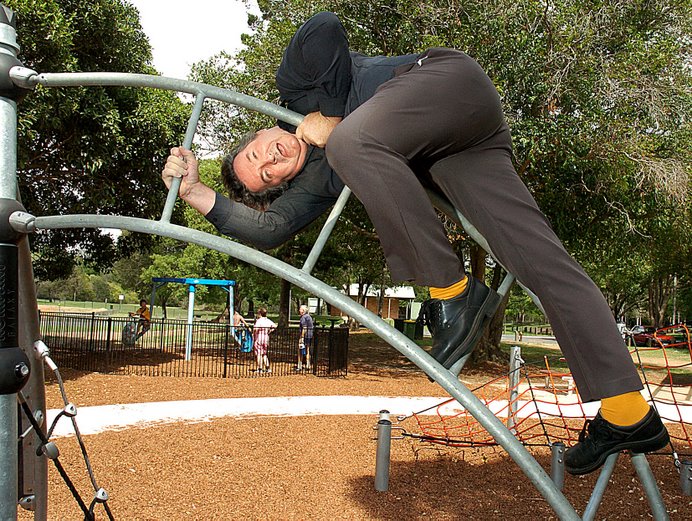
What were film maker Robert Martin and I thinking when we created a 9-minute video for You Tube?
Oh dear, that's the electronic equivalent of War and Peace.
We are not totally stupid becaue we made a shorter vid more attuned to the average You Tube attention span. But we lost that one.
Anyway, if you want to try an assault on our 9-minute epic, pour yourself a big mug of coffee and switch on.
http://www.youtube.com/watch?v=uUje6RE3u_I&eurl
Wednesday, May 7, 2008

Wednesday, April 2, 2008
You will see an image of the story of my book launch in Brisbane.
You can buy my book at ASmazon and its affiiliates if you live in America or Europe.
In Australia and Asia, buy it from www.digitalprintaustralia.com
Cheers
Bernie
You can buy my book at ASmazon and its affiiliates if you live in America or Europe.
In Australia and Asia, buy it from www.digitalprintaustralia.com
Cheers
Bernie
Sunday, November 25, 2007
Karma Election Konnection
SATURDAY's Australian Federal Election sweeps aside a conservative government in what must go down as a karma election.The Liberal-National Party won the 1904 election on the back of a largely fraudulent fear campaign that interest rates would rise sharply under a Labor Government.It was fraudulent because who was in political power was way down the list of determining the level of interest rates.Half a dozen interest rate rises since the 2004 conservative victory hurt the incumbent government severely. Karma Konnection #1.IN 2004, the Coalition won control of both houses of Parliament: the House of Representatives and the Senate, considered a house of review.Even Conservative voters expressed their concerns about the control of the Senate rather than having a balance of power, through the Greens, the Democrats and independents.Prime Minister John Howard was one who relished control of both houses.He introduced draconian workplace industrial relations changes in the form of WorkChoices.He had not discussed the legislation during his election campaign and he would never been able to introduce the legislation in a hung senate.Most Australians hated the new legislation which took away income and conditions from workers to give bosses more profits and control over their employees.Howard, a political opportunist its of the highest calibre, has made similar misjudgements in the past and been able to recant near an election.But because this massive piece of legislation had passed through both houses and was implemented in all its complicated glory, it could not be unravelled.The fortune of Coalition control of the Senate became the misfortune of an electoral nightmare as Australians took their revenge against WorkChoices. Karma Konnection #2.Cunning was one of the hallmarks of a the Coalition government and one its strategies was to make members from previously marginal seats Ministers.Examples of these in the State of Queensland were Family and Community Services Minister Mal Brough, Queenslander Assistant Treasurer Peter Dutton, while Theresa Gambaro was a parliamentary secretary.Brough and Gambaro are gone and Dutton will probably go too.In New South Wales Special Minister for State Gary Nairn and Roads Minister Jim Lloydlost their seats.These people were appointed mainly for short term electoral gain of retaining semi-marginal seats.The loss of their seats will hinder the long-term operation of the Coalition in opposition when it has to retrain people for its front bench. Karma Konnection #3.Look out the window: something might be blowing in the wind.
Tuesday, November 6, 2007
Australian Federal Election
I WAS more nervous than I thought I would be at the prospect of interviewing Australia's next Prime Minister Kevin Rudd.
I'm Bernie Dowling, 53-years-old, and I have been a newspaper reporter for half my life.
We are three-weeks into a six-week election campaign to decide whether Australia has had enough of a conservative Liberal Party government and wants a slightly less conservative Rudd-led Labor Party government instead.
The newspapers I write for are the Wednesday and Friday weeklies, the Pine Rivers Press and the Northern Times.
We receive the call on Thursday morning. Labor leader Kevin Rudd is on the hustings in our shire that arvo.
He is doing the rounds of three shopping centres, in three electorates, none held by his Labor Party, and all within an area of 30 kilometres.
Westfield Strathpine, bang in the heart of the electorate of Dickson and also our shire of Pine Rivers, is his third port of call.
We arrange a couple of photographers because it is basically a photo-op gig, but I tag along, anyway.
Almost all of the electorate of Dickson, held for the conservatives, or rather the more-conservatives, by ex-copper and junior Minister Peter Dutton, is in the shire of Pine Rivers, our turf.
I am hoping it is an easy gig where I watch and record, as Rudd and Labor candidate Fiona McNamara press the flesh, bounce the bubbas and smile for the shooters, using cameras not guns.
Peter Dutton has to surrender an 8.9% lead to lose his seat, an impossibility in normal times.
It is not normal times. The Liberal-National Party coalition is on the nose because of its WorkChoices industrial relations system, an income redistribution scheme to take money from employees to give to employers.
Fiona McNamara is a likeable candidate with the common touch, and she seems to be running a genuine grass-roots campaign, rather than just saying she is.
I have the feeling she is going to set me up with an interview with Rudd.
Not because she respects me as a bright insightful reporter.
Certainly not because she wants to see me on the TV news with her champion. I am a pretty scruffy sort of bloke. I have a haircut 1-3 months after I need one. I wear the best shirts China can make to retail at $10 a pop. In short, I have a great look for radio and most of my newspaper headshots are embarrassing.
I have already given the reason Australia's next Prime Minister Kevin Rudd wants to talk to me. Our newspaper the Pine Rivers Press reaches most of the voters of Dickson.
We in Pine Rivers are just north of the capital of Brisbane where the State of Queensland's major metro daily, the Courier Mail is based. Rudd and McNamara probably might think a few lines in the prestigious Courier-Mail are worth more than a page in the Pine Rivers Press, even though the Press raches a lot more Dickson readers than the Courier. And they know they can have that page in the Press and only salivate over those lines in the Courier.
Come in wild-manicured reporter Bernie Dowling and his nervous interview with Kevin Rudd.
I am unsure why I am nervous. I am a true democrat, valuing character over social position. Perhaps it is I have never met Rudd or I am wary of his social conservatism. It is probably I am just scared of authority, like a lot of us.
When a copper comes knocking on your door or a teacher asks you a sarcastic question, it is never going to end well.
My interview with Rudd is always going to end well.
As soon as I am asking the questions, I am in the groove. Asking questions gives you a bit of an edge, a piece of authority.
I have not prepared any questions, but then I do not do that much anymore, anyway.
I am not a big-city TV talking head, trying to catch the pollie out on a question I know the answer to only because a research assistant told me.
I do not ask Rudd what is the next railway stop, north of Strathpine. I ask him whether Fiona McNamara can take Peter Dutton down.
I am impressed with Kevin Rudd's answer, after the usuals spin of how wonderful a candidate Macca is, followed by a delightful and accurate working-class horse-racing analogy of how she is going to take Dutton down to the wire.
Maybe Kevin Rudd has a little pride in his working class background, after all. Our last Labor Prime Minister Paul Keating chastised working-class Australians for not aspiring for more than living in fibro houses.
A lot of good people lived in fibro houses. It is a shame they had to risk cancer from asbestos doing it.
On the Tuesday after our interview, Kevin Rudd backs the winner of the Melbourne Cup. The horse is named Efficient, in a week when the two major parties are arguing which can better manage the Australian Economy.
Efficient is alright as far as an image goes, but, at its best, it is a trifle dull; and at it worst, evokes pictures of efficiency experts, stop watches in hand, ringing blood, sweat and tears from honest toilers.
It is a pity but no horse called Visionary runs in this year’s Melbourne Cup.
Spread the news
Bernie
I'm Bernie Dowling, 53-years-old, and I have been a newspaper reporter for half my life.
We are three-weeks into a six-week election campaign to decide whether Australia has had enough of a conservative Liberal Party government and wants a slightly less conservative Rudd-led Labor Party government instead.
The newspapers I write for are the Wednesday and Friday weeklies, the Pine Rivers Press and the Northern Times.
We receive the call on Thursday morning. Labor leader Kevin Rudd is on the hustings in our shire that arvo.
He is doing the rounds of three shopping centres, in three electorates, none held by his Labor Party, and all within an area of 30 kilometres.
Westfield Strathpine, bang in the heart of the electorate of Dickson and also our shire of Pine Rivers, is his third port of call.
We arrange a couple of photographers because it is basically a photo-op gig, but I tag along, anyway.
Almost all of the electorate of Dickson, held for the conservatives, or rather the more-conservatives, by ex-copper and junior Minister Peter Dutton, is in the shire of Pine Rivers, our turf.
I am hoping it is an easy gig where I watch and record, as Rudd and Labor candidate Fiona McNamara press the flesh, bounce the bubbas and smile for the shooters, using cameras not guns.
Peter Dutton has to surrender an 8.9% lead to lose his seat, an impossibility in normal times.
It is not normal times. The Liberal-National Party coalition is on the nose because of its WorkChoices industrial relations system, an income redistribution scheme to take money from employees to give to employers.
Fiona McNamara is a likeable candidate with the common touch, and she seems to be running a genuine grass-roots campaign, rather than just saying she is.
I have the feeling she is going to set me up with an interview with Rudd.
Not because she respects me as a bright insightful reporter.
Certainly not because she wants to see me on the TV news with her champion. I am a pretty scruffy sort of bloke. I have a haircut 1-3 months after I need one. I wear the best shirts China can make to retail at $10 a pop. In short, I have a great look for radio and most of my newspaper headshots are embarrassing.
I have already given the reason Australia's next Prime Minister Kevin Rudd wants to talk to me. Our newspaper the Pine Rivers Press reaches most of the voters of Dickson.
We in Pine Rivers are just north of the capital of Brisbane where the State of Queensland's major metro daily, the Courier Mail is based. Rudd and McNamara probably might think a few lines in the prestigious Courier-Mail are worth more than a page in the Pine Rivers Press, even though the Press raches a lot more Dickson readers than the Courier. And they know they can have that page in the Press and only salivate over those lines in the Courier.
Come in wild-manicured reporter Bernie Dowling and his nervous interview with Kevin Rudd.
I am unsure why I am nervous. I am a true democrat, valuing character over social position. Perhaps it is I have never met Rudd or I am wary of his social conservatism. It is probably I am just scared of authority, like a lot of us.
When a copper comes knocking on your door or a teacher asks you a sarcastic question, it is never going to end well.
My interview with Rudd is always going to end well.
As soon as I am asking the questions, I am in the groove. Asking questions gives you a bit of an edge, a piece of authority.
I have not prepared any questions, but then I do not do that much anymore, anyway.
I am not a big-city TV talking head, trying to catch the pollie out on a question I know the answer to only because a research assistant told me.
I do not ask Rudd what is the next railway stop, north of Strathpine. I ask him whether Fiona McNamara can take Peter Dutton down.
I am impressed with Kevin Rudd's answer, after the usuals spin of how wonderful a candidate Macca is, followed by a delightful and accurate working-class horse-racing analogy of how she is going to take Dutton down to the wire.
Maybe Kevin Rudd has a little pride in his working class background, after all. Our last Labor Prime Minister Paul Keating chastised working-class Australians for not aspiring for more than living in fibro houses.
A lot of good people lived in fibro houses. It is a shame they had to risk cancer from asbestos doing it.
On the Tuesday after our interview, Kevin Rudd backs the winner of the Melbourne Cup. The horse is named Efficient, in a week when the two major parties are arguing which can better manage the Australian Economy.
Efficient is alright as far as an image goes, but, at its best, it is a trifle dull; and at it worst, evokes pictures of efficiency experts, stop watches in hand, ringing blood, sweat and tears from honest toilers.
It is a pity but no horse called Visionary runs in this year’s Melbourne Cup.
Spread the news
Bernie
Sunday, September 30, 2007
Top 10 greatest popular song lyrics of all time
I think they should be one or two lines rather than full stanzas, because brevity is the eternal soul of wit. But that's up to you.
1. Substitute you for my mom;
At least I'll get my washing done.
From Substitute by The Who.
2. Dialing for Dollars is waiting to find me.
I wait for delivery each day until 3.
From Mercedes Benz by Janis Joplin
3. An' tell me, over and over again, my friend,
You don't believe we're on the eve of destruction
From The Eve of Destruction by Barry McGuire.
4. And run, if you will, to the top of the hill, pretty Jean.
From Jean by Oliver.
5. Get up, stand up for your rights.
Don't give up the fight.
From Get Up, Stand Up by The (Original) Wailers.
6. Don't it always seem to go
You don't know what you got 'til it's gone.
From Big Yellow Taxi by Joni Mitchell.
7. There's room at the top, they're telling you sti-il
But first you got to learn how to smile as you ki-ill.
From Working Class Hero by John Lennon.
8. Say it in bro-oken English.
From Broken English by Marianne Faithful.
9. Wake me up when September's gone.
(It lacks timelessness but it's perfect for our times.)
From Wake Me Up When September's Gone by Green Day.
10. Watch the butcher shine his knives
And this town is full of battered wives.
From The Streets of Your Town by The Go-Betweens.
I've left out Dylan, Zappa, Eminem, Rodriguez, Patti Smith, Neil Young, Carole King, Billy Bragg, Paul Kelly, Eric Burdon, Iggy Pop, The Beatles, The Doors, The Rolling Stones, Steppenwolf, The Grateful Dead, Velvet Underground, Talking Heads, AC/DC, The Clash, Dire Straits, R.E.M., U2, Crowded House, NWA, Faith No More, Nirvana, and so many more. What have I done?
Spread the news,
Bernie
1. Substitute you for my mom;
At least I'll get my washing done.
From Substitute by The Who.
2. Dialing for Dollars is waiting to find me.
I wait for delivery each day until 3.
From Mercedes Benz by Janis Joplin
3. An' tell me, over and over again, my friend,
You don't believe we're on the eve of destruction
From The Eve of Destruction by Barry McGuire.
4. And run, if you will, to the top of the hill, pretty Jean.
From Jean by Oliver.
5. Get up, stand up for your rights.
Don't give up the fight.
From Get Up, Stand Up by The (Original) Wailers.
6. Don't it always seem to go
You don't know what you got 'til it's gone.
From Big Yellow Taxi by Joni Mitchell.
7. There's room at the top, they're telling you sti-il
But first you got to learn how to smile as you ki-ill.
From Working Class Hero by John Lennon.
8. Say it in bro-oken English.
From Broken English by Marianne Faithful.
9. Wake me up when September's gone.
(It lacks timelessness but it's perfect for our times.)
From Wake Me Up When September's Gone by Green Day.
10. Watch the butcher shine his knives
And this town is full of battered wives.
From The Streets of Your Town by The Go-Betweens.
I've left out Dylan, Zappa, Eminem, Rodriguez, Patti Smith, Neil Young, Carole King, Billy Bragg, Paul Kelly, Eric Burdon, Iggy Pop, The Beatles, The Doors, The Rolling Stones, Steppenwolf, The Grateful Dead, Velvet Underground, Talking Heads, AC/DC, The Clash, Dire Straits, R.E.M., U2, Crowded House, NWA, Faith No More, Nirvana, and so many more. What have I done?
Spread the news,
Bernie
Monday, September 17, 2007
From genre to v. good
WHENEVER you feel you might be writing something hardly worth reading, you can always quote American author Gore Vidal.
Vidal said: 'American writers want to be not good but great; and so are neither.'
I wonder whether Vidal was commenting also on American foreign policy since that country long ago dumped the philosophy of isolationism into history's dustbin. A monstrous heroic adventure is easy to justify in terms of greatness, while finding the goodness in doing the right thing can be a pains-taking task.
Thankfully, I am not pursuing such weighty moral questions here, but glancing at what makes good writing.
My novel Iraqi Icicle is from the detective thriller genre which began with the works of Raymond Chandler last century after World War I. I have tried to transcend the genre to make my novel good, or, I hope, verging on the very good.
Genres rarely rate much above a pass mark from critical judges. In many cases, you can see why. Thriller writers, even the best of them, tend to attain their loyal following by repeating a winning formula. We have the hugely ironic situation that most of the world's leading novelists achieve fame and fotune by producing books which are not novel; which are, in fact, the antithesis of newness. Their successful novels should be called repetitives. Don't miss Dan B. Rowling's latest blockbuster repetitive.
I believe this phenomenon of successful writing is tied to readers' comfort in the known rather than being a shortcoming of genres.
My favourite analogy on this topic is the career of British rock group The Beatles who started as imitators of the American genre, rhythm&blues. That was 1950s R&B, not the modern one where young Black, and sometimes, White women sing out loud on a beach or on the street where they just happen to have 33 people dancing sexily behind them.
The Beatles transcended their choice of genre to produce greatness. I would like to do that with the detective thriller genre. Only, remembering Vidal's warning, I am only after very goodness.
Irai Icicle is available in Europe and the Americas from www.Amazon.com www.Abebooks.com www.Alibris.com and www.Borders.com and www.lulu.com and www.lulu.com/uk and in Autralia and Asia from www.digitalprintaustralia.com
Spread the news
Bernie
Vidal said: 'American writers want to be not good but great; and so are neither.'
I wonder whether Vidal was commenting also on American foreign policy since that country long ago dumped the philosophy of isolationism into history's dustbin. A monstrous heroic adventure is easy to justify in terms of greatness, while finding the goodness in doing the right thing can be a pains-taking task.
Thankfully, I am not pursuing such weighty moral questions here, but glancing at what makes good writing.
My novel Iraqi Icicle is from the detective thriller genre which began with the works of Raymond Chandler last century after World War I. I have tried to transcend the genre to make my novel good, or, I hope, verging on the very good.
Genres rarely rate much above a pass mark from critical judges. In many cases, you can see why. Thriller writers, even the best of them, tend to attain their loyal following by repeating a winning formula. We have the hugely ironic situation that most of the world's leading novelists achieve fame and fotune by producing books which are not novel; which are, in fact, the antithesis of newness. Their successful novels should be called repetitives. Don't miss Dan B. Rowling's latest blockbuster repetitive.
I believe this phenomenon of successful writing is tied to readers' comfort in the known rather than being a shortcoming of genres.
My favourite analogy on this topic is the career of British rock group The Beatles who started as imitators of the American genre, rhythm&blues. That was 1950s R&B, not the modern one where young Black, and sometimes, White women sing out loud on a beach or on the street where they just happen to have 33 people dancing sexily behind them.
The Beatles transcended their choice of genre to produce greatness. I would like to do that with the detective thriller genre. Only, remembering Vidal's warning, I am only after very goodness.
Irai Icicle is available in Europe and the Americas from www.Amazon.com www.Abebooks.com www.Alibris.com and www.Borders.com and www.lulu.com and www.lulu.com/uk and in Autralia and Asia from www.digitalprintaustralia.com
Spread the news
Bernie
Wednesday, September 12, 2007
Drugs 'n' sex `n' rock `n' roll
BLUES-rock diva Janis Joplin liked to shout at her concerts that drugs 'n' sex `n' rock `n' roll would get us well; would get the whole world well.
Joplin died of a heroin overdose at the age of 27.
Janis was not around Brisbane between 1986 and 1992, the setting and time frame of Queensland journalist Bernie Dowling's first novel Iraqi Icicle. But drugs `n' sex `n' rock roll certainly were. In spades. Along with war.
In October 1970, when Janis died, heroin was an international scourge and America and its allies were prosecuting the Vietnam War.
In January 1991, heroin was an internatonal scourge and America and its allies were prosecuting the first Iraq War, also called the Persian Gulf War.
Janis Joplin rates a passing reference in Iraqi Icicle, a private detective thriller with an unlikely sleuth, Steele Hill, an orphan who claims to be John Lennon's love child and lives for gambling and altrnative rock music.
``I am interested in how popular culture, such as music, film, television, theatre, the internet, gambling and even drug use, intersects with mega social events,'' Dowling says.
Brisbane rock band the Go-Betweens is a symbolic character with the novel asking why the Aussie alternative guitar popsters never gained the success of their American contemporaries R.E.M. or even Britband The Smiths.
A Go-Betweens gig at the University of Queensland is in the mix as well as the destruction of Brisbane's hilltop rock concert venue Cloudland where the Go-Betweens supported Brit ska band Madness in the early 1980s.
The novel questions whether rock music lived up to Joplin's boast of it changing the world.
Whenever he drives by, Steele Hill shakes his fist at the yuppie white apartments which replaced Cloudland and he says the Go-Betweens wrote a song about the ballroom's demolition.
He is referring to a few lines from the band's most successful single The Streets of Your Town.
Dowling's novel never leaves Greater Brisbane but it includes Steele Hill's take on the rock music mythology of the 1989 American invasion of Panama.
The pretext for the action was to bring Panamanian president Manuel Noriega to justice for drugs and arms trading.
The international media reported, with varying degrees of accuracy, how American troops blasted rock music at the Vatican embassy where Noriega had refuge before he surrendered.
Steele Hill calls it ``rock's part in Manny's downfall'' and suggests Noriega begged the invaders to stop the music. ``No more Twisted Sister; no more We're Not Gonna Take It,'' Steele Hill imagines Noriega pleading.
Iraqi Icicle is a darkly humorous novel of a period which saw the explosion of personal computers and mobile phones in Australia, and, in Queensland, the Fitzgerald Inquiry into police corruption which toppled the long-serving Joh Bjelke-Petersen government.
Iraqi Icicle is available from www.digitalprintaustralia.com www.amazon.com www.abebooks.com www.alibris.com www.lulu.com/uk and www.borders.com
Joplin died of a heroin overdose at the age of 27.
Janis was not around Brisbane between 1986 and 1992, the setting and time frame of Queensland journalist Bernie Dowling's first novel Iraqi Icicle. But drugs `n' sex `n' rock roll certainly were. In spades. Along with war.
In October 1970, when Janis died, heroin was an international scourge and America and its allies were prosecuting the Vietnam War.
In January 1991, heroin was an internatonal scourge and America and its allies were prosecuting the first Iraq War, also called the Persian Gulf War.
Janis Joplin rates a passing reference in Iraqi Icicle, a private detective thriller with an unlikely sleuth, Steele Hill, an orphan who claims to be John Lennon's love child and lives for gambling and altrnative rock music.
``I am interested in how popular culture, such as music, film, television, theatre, the internet, gambling and even drug use, intersects with mega social events,'' Dowling says.
Brisbane rock band the Go-Betweens is a symbolic character with the novel asking why the Aussie alternative guitar popsters never gained the success of their American contemporaries R.E.M. or even Britband The Smiths.
A Go-Betweens gig at the University of Queensland is in the mix as well as the destruction of Brisbane's hilltop rock concert venue Cloudland where the Go-Betweens supported Brit ska band Madness in the early 1980s.
The novel questions whether rock music lived up to Joplin's boast of it changing the world.
Whenever he drives by, Steele Hill shakes his fist at the yuppie white apartments which replaced Cloudland and he says the Go-Betweens wrote a song about the ballroom's demolition.
He is referring to a few lines from the band's most successful single The Streets of Your Town.
Dowling's novel never leaves Greater Brisbane but it includes Steele Hill's take on the rock music mythology of the 1989 American invasion of Panama.
The pretext for the action was to bring Panamanian president Manuel Noriega to justice for drugs and arms trading.
The international media reported, with varying degrees of accuracy, how American troops blasted rock music at the Vatican embassy where Noriega had refuge before he surrendered.
Steele Hill calls it ``rock's part in Manny's downfall'' and suggests Noriega begged the invaders to stop the music. ``No more Twisted Sister; no more We're Not Gonna Take It,'' Steele Hill imagines Noriega pleading.
Iraqi Icicle is a darkly humorous novel of a period which saw the explosion of personal computers and mobile phones in Australia, and, in Queensland, the Fitzgerald Inquiry into police corruption which toppled the long-serving Joh Bjelke-Petersen government.
Iraqi Icicle is available from www.digitalprintaustralia.com www.amazon.com www.abebooks.com www.alibris.com www.lulu.com/uk and www.borders.com
Subscribe to:
Posts (Atom)